
CELEBRITY
BREAKING 🚨 Trump is now demanding that Venezuela’s acting leader officially recognize Nicolás Maduro as the legitimate president following his shocking capture by the US last month. 🇺🇸🇻🇪 A massive diplomatic twist that completely scrambles Washington’s endgame in South America. 🌍⚖️🔥 Why do you think the US is suddenly insisting on his legitimacy right after capturing him?

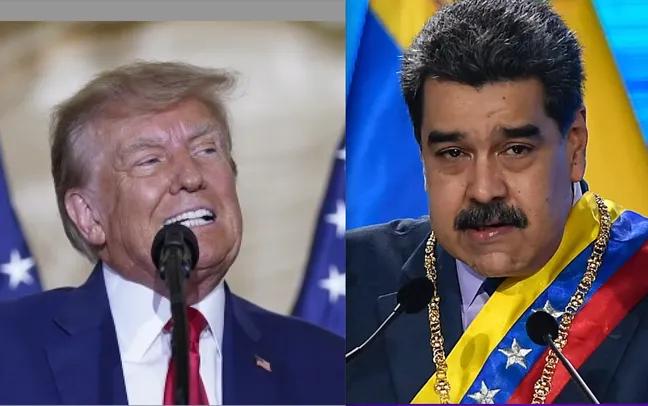


In early January 2026, the U.S. conducted a military operation in Venezuela, captured President Nicolás Maduro and brought him to the U.S. to face narcoterrorism and drug-trafficking charges. �
Venezuela’s Constitutional Chamber then named Delcy Rodríguez as the acting president in Maduro’s absence. �
Recently, President Trump said Rodríguez “has to say” Maduro is Venezuela’s legitimate leader, and that this may be a political necessity for their relationship. �
So why this sudden insistence? Here are a few key reasons analysts are suggesting:
🧠 1. Avoid a power vacuum and build stability
When the U.S. removed Maduro by force, Venezuela was left without its usual leader, and there was massive uncertainty across government institutions.
For practical diplomacy — especially if the U.S. wants Venezuelan cooperation on issues like oil, trade, and politics — it may be easier to work with someone who publicly defends Maduro’s legacy and legitimacy. Forcing a hard break could have led to chaos. �
🛢 2. Economic and oil interests
Venezuela has some of the largest oil reserves in the world.
The U.S. — and American oil companies — have strong incentives to stabilize relations and get access to those resources again. Trump officials have already visited Venezuela to promote investment and repair infrastructure. �
If Rodríguez openly rejects Maduro now, she could risk losing support from domestic political forces and Venezuelan oil elites. Trump may be allowing political cover so diplomatic and economic engagement can move forward more smoothly.
🧩 3. A diplomatic balancing act
Trump’s statement that Rodríguez “probably has to say that” Maduro is legitimate sounds like realpolitik — a way of diplomatically acknowledging Venezuelan public sentiment and internal politics while still pursuing U.S. interests. It’s not so much about recognizing Maduro as president in practice, but rather keeping dialogue open. �
In other words:
The U.S. still holds Maduro in custody.
But insisting that Venezuela’s acting leader rejects him outright could make it much harder to engage constructively with Caracas. So this is a tactical acknowledgment, not a full reversal of U.S. legal actions.
🤝 4. Reducing regional backlash
The military operation sparked widespread international criticism, including from major world powers, regional blocs, and legal experts who say the raid violated international law and Venezuela’s sovereignty. �
Insisting that Venezuela’s own government recognizes Maduro as legitimate might be a move to reduce diplomatic isolation and signal that Washington isn’t trying to permanently overthrow Venezuelan institutions.
Trump’s recent push for Rodríguez to say Maduro is the legitimate leader isn’t about restoring Maduro to power in Washington’s view. Instead, it appears to be:
A practical political strategy to avoid chaos in Venezuela’s governance.
A way to smooth economic and diplomatic engagement (especially over oil).
A move to reduce regional and global criticism of U.S. intervention.
This is a very unusual moment in international politics — a mix of military power, diplomacy, economic interests, and legitimacy disputes all colliding at once.
JUST IN: I don’t want Trump merely impeached!!!Trump’s time is coming to an end! Sooner or later he will have to leave office. If Democrats get a majority after the midterms investigations will start. Commissions will be named. All that evidence will be turned over to a new AG that is the opposite from Bondi! Convicted will come. Click the link below to know who made the statement and all it entails 👇🏾👇🏾👇🏾

BREAKING: 🇺🇸 Former U.S. President, Barack Obama: “They ask me about Trump’s latest ‘post.’ We could spend the whole day reacting to every buffoonish spectacle coming out of the White House, but that’s exactly what they want: for us to lose focus. Politics used to have a limit of shame. Today, it seems the strategy is simply to exhaust our capacity for astonishment. Don’t be distracted by the noise; watch what they are doing to your rights while you stare at the screen.”

BREAKING 🚨 Trump is now demanding that Venezuela’s acting leader officially recognize Nicolás Maduro as the legitimate president following his shocking capture by the US last month. 🇺🇸🇻🇪 A massive diplomatic twist that completely scrambles Washington’s endgame in South America. 🌍⚖️🔥 Why do you think the US is suddenly insisting on his legitimacy right after capturing him?

JUST IN: Supreme Court Officially Summons President Donald Trump After He Refuses to Answer Federal Inquiries and Multiple Lawsuits, Including a $10 Billion Case Filed by the National Trust for Historic Preservation Over the Illegal Demolition of the White House East Wing

💥BREAKING: 🇺🇸 Democrats plan to impeach and remove both Trump and Vance if they win the 2026 midterms. Polymarket estimates that Democrats have a 79% chance of winning the midterm elections. Raise your hand if you want Trump impeached immediately ✋

SAD😢: Unforeseen Disruption Forces Patrick Mahomes-Travis Kelce’s Business Partnership to Shut Down on Thursday. Read more below for full story 👇🏾👇🏾👇🏾

NFL News: Andy Reid and Chiefs could lose 3x Super Bowl champion in blockbuster trade for 2026 after Patrick Mahomes’ injury

BREAKING:Jasmine Crockett bashes Pam Bondi over Epstein files, questions Trump ties at congressional hearing

Trump: “Say Whatever You Want — I Can’t Be Impeached, I’ll Run Again, and I’ll Win”

Hillary Clinton: Trump has betrayed the West… Raise your hand if you want Trump impeached immediately ✋

Obama knew what Trump was, he warned everyone, and y’all accused him of overreacting. Raise your hand if you agree Barack Obama is 1000X better than Trump ✋
