
CELEBRITY
“Donald Trump is unfit to be president. He’s corrupt, a serial liar, and he’s covering up the Epstein files,” Rep. Ted Lieu Do you agree with Ted Lieu?

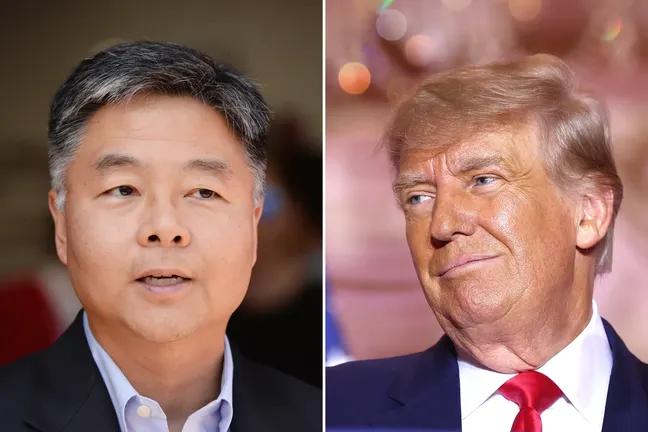
Ted Lieu has sharply criticized former President Donald Trump, calling him “unfit to be president” and accusing him of corruption, dishonesty, and involvement in withholding information related to the late financier Jeffrey Epstein.
Lieu’s remarks come amid renewed political tensions in Washington, where debates over transparency, accountability, and past investigations continue to divide lawmakers and voters alike.
The Allegations
In his statement, Lieu described Trump as “corrupt” and a “serial liar,” further alleging that Trump is covering up files connected to Epstein. The so-called “Epstein files” generally refer to court documents, investigative materials, and records linked to Epstein’s criminal cases and his network of high-profile associates.
Epstein, who was arrested in 2019 on federal sex trafficking charges, died in jail later that year while awaiting trial. His case sparked widespread public interest due to his connections with influential figures across politics, business, and entertainment. Over time, various documents have been unsealed, but some records remain sealed or partially redacted, fueling speculation and political accusations.
Trump’s Position
Trump has previously denied any wrongdoing related to Epstein and has stated that he had a falling out with him years before Epstein’s arrest. There has been no court ruling establishing that Trump engaged in criminal conduct tied to Epstein’s trafficking operation.
Supporters of the former president argue that accusations about “cover-ups” are politically motivated and lack verified evidence. They also point to ongoing investigations and court proceedings as proof that the legal system continues to function independently.
Broader Political Context
Lieu’s comments reflect a broader pattern of sharp rhetoric between Democratic lawmakers and Trump, who remains a dominant figure in American politics. Critics argue that Trump’s legal challenges and past controversies raise serious concerns about leadership and accountability. Supporters counter that he is being unfairly targeted for political reasons.
As the political climate intensifies, statements like Lieu’s are likely to deepen partisan divides, particularly as discussions about transparency, public trust, and the handling of sensitive investigative records continue.
For now, the debate remains largely political — with definitive legal conclusions depending on ongoing investigations and official disclosures rather than rhetoric alone.

“The Supreme Court on Friday dealt President Donald Trump perhaps the most significant rebuke of his second term,” writes Aaron Blake. “The justices, including two of the president’s appointees, struck down Trump’s signature economic policy: his global tariffs.”

“Donald Trump is unfit to be president. He’s corrupt, a serial liar, and he’s covering up the Epstein files,” Rep. Ted Lieu Do you agree with Ted Lieu?

🚨BREAKING: Trump says he’ll sign an executive order today imposing a new 10% global tariff—this time under Section 122 of the Trade Act of 1974, which allows a temporary import surcharge of up to 15% for up to 150 days to address “large and serious” balance-of-payments issues. He says existing Section 232 and Section 301 tariffs remain in effect.

Good lord, this rambling idiot on TV is actually the president of the most powerful country on the planet? How the hell do we as a nation allow this shitshow to continue? He has completely destroyed our global reputation. 😢😢😢

🚨 JUST IN: Governor Gavin Newsom is calling for Donald Trump to issue immediate tariff refund checks — with interest — following today’s Supreme Court ruling! Raise your hand if you want Trump impeached immediately ✋

The Supreme Court just blocked Trump’s big tariffs plan under emergency powers, ruling 6-3 against him. Raise your hand if you want Trump impeached immediately ✋

U.S. Senators have taken the STUNNING step of officially calling for President Trump’s removal from office under the 25th Amendment…

JUST IN: Taylor Swift Showered With $141K in Gifts as Travis Kelce Kicks Off Wedding Countdown. Click for more below 👇🏾👇🏾👇🏾

🇺🇸🚨 – U.S. Senators have officially called for President Trump’s removal from office under the 25th Amendment.
JUST IN: I don’t want Trump merely impeached!!!Trump’s time is coming to an end! Sooner or later he will have to leave office. If Democrats get a majority after the midterms investigations will start. Commissions will be named. All that evidence will be turned over to a new AG that is the opposite from Bondi! Convicted will come. Click the link below to know who made the statement and all it entails 👇🏾👇🏾👇🏾

BREAKING: 🇺🇸 Former U.S. President, Barack Obama: “They ask me about Trump’s latest ‘post.’ We could spend the whole day reacting to every buffoonish spectacle coming out of the White House, but that’s exactly what they want: for us to lose focus. Politics used to have a limit of shame. Today, it seems the strategy is simply to exhaust our capacity for astonishment. Don’t be distracted by the noise; watch what they are doing to your rights while you stare at the screen.”
